How to uncover the hidden knowledge in your organization
The right knowledge can take your organization to new heights. Unfortunately, a lot of it is hidden. Whether it’s buried in the depths of your employee experience platform, lurking in a forgotten corner of your document management system, or residing in the minds of your employees, here are the best ways to uncover and amplify your knowledge.

First things first: What kind of knowledge are we looking for?

Explicit knowledge
Knowing what
Knowledge based on facts, rules, and data
Easy to articulate, document, and pass on to others
Examples: Employee handbook, processes and procedures, market research, quarterly sales numbers, IT guidelines

Implicit knowledge
Knowing how
Knowledge based on experience, skills, and intuition
More difficult to express, codify and centralize
Examples: How to build rapport with potential clients, key elements of past successful projects, the right contact to collaborate with in another department
Now that we know what we’re looking for, how do we find it?
Stop, look, and listen
Assess the current state of knowledge at your organization to get a sense of how well it is shared, and which types of information may be missing or difficult to locate.
Map it out
Where does your knowledge live today, and how does it spread? The more technology you have in place for communication and collaboration, the more places there are for knowledge to hide.
Create a comprehensive list of all the knowledge pathways in your organization, including messaging apps, document management solutions, email, and more. Identifying these locations will tell you where to look.


Get analytical
If your digital workplace has strong analytics capabilities, now’s the time to put them to work. Try looking at these areas to identify hidden content, figuring out what you may need to reinvigorate or make more accessible:

Search
Employees search for information every day, but how successful are these searches? What are the most-searched terms, and are they leading employees to the knowledge they’re looking for? Are there repeat keywords that yield no results?
Intranet traffic
Look at how your users are traveling through your intranet. Where do they spend the most time? Is there crucial information that isn’t getting enough visibility? Is there outdated documentation that’s getting too much?
Survey the scene
When it comes to organizational knowledge, employees are experts. They are the ones who hold, create, share, retrieve, and apply it on a daily basis. Asking their opinion via surveys and focus groups will give you valuable insight into what knowledge they need most and how easy it is for them to find it.

Not sure what to ask? Start with these 6 questions:
1. Which areas of the organization or business do you feel you need to know more about?
2. Are there any specific departments or teams that you have trouble finding information related to?
3. On a scale of 1–5, how easy is it to locate the information, documents, and people you need to complete day-to-day tasks?
4. Agree or disagree: “When I need to know something, I can usually find answers on the digital workplace with a few clicks.”
5. How often do you contribute your own insights or knowledge at work to those outside your department?
(a) Very often, (b) Often, (c) Sometimes, (d) Rarely, or (e) Never
6. What do you think are the main challenges employees at our organization face when it comes to knowledge sharing?
Uncovering explicit knowledge
Now that you’ve got a better picture of the current state of knowledge in your organization, you can dive into uncovering and amplifying the information your workforce needs to thrive.

Run a content audit
In your assessment of knowledge in your digital workplace, have you come across outdated, duplicated, or poorly executed content? Well, the knowledge your employees need is hidden among and behind it.
Laying all your digital workplace content out in one place, along with authors, publish dates, and other important data, will help you find useful knowledge you didn’t know you had, and cut down on the volume of information so the important, relevant knowledge can emerge and take its rightful place: front and center.

Centralize and organize
Centralizing organizational knowledge creates a one-stop shop for documents, policies, processes, insights, and more, so you have a place for everything, and (hopefully) everything in its place.
Consolidating your technology will allow you to capture knowledge previously shared on other platforms. An organized system for information will encourage employees to add key knowledge in the right places, such as department pages. Strong search capabilities and tagging by category, author, keywords, date, and more will bring the knowledge out of hiding even further.
Uncovering implicit knowledge
Implicit knowledge can be the secret sauce that sets high-performing organizations apart. It’s also hard to capture. Without the right strategy it can remain stuck in employees’ brains, ultimately departing with them when they move on from your organization. Here are some tips to help you find and preserve it:

Enable your experts

A place to ask questions and get answers
It’s natural for workers seeking out knowledge to turn to colleagues. But when questions are asked in a private meeting or message, the rest of the organization misses out. In a well-organized forum system, employees ask questions, and their colleagues can provide answers. This starts a public, documented, and searchable conversation among many voices, which can lead not only to an exchange of knowledge, but also to unexpected and innovative results.

Be a knowledge matchmaker
A dynamic people directory can help employees hunt down colleagues with certain expertise, skills, or credentials. If they need someone who knows a certain coding language or has a specific certification, they’ll be able to locate them instantly and benefit from their knowledge.
Use tech to your advantage
The right technology makes it easier for employees to contribute to and locate key knowledge. Take advantage of these features in your employee experience platform to up your organization’s knowledge game and bring crucial information out of hiding:


AI-powered content creation helps ensure employee-created knowledge is easy to understand, digest, and locate.

Intelligent search, with features such as semantic analysis, precise filtering, predictive suggestions, personalization, and more, makes it easy for employees to uncover the knowledge they need in seconds.
Pages and communities in your digital workplace provide dedicated homes for department, team, or project-specific knowledge so that employees know where to look for and share relevant information.
Personalization ensures that employees see the knowledge that’s the most relevant and helpful to their roles, locations, and areas of business.
Automated translation capabilities enable employees from around the world to share knowledge they wouldn’t be able to otherwise.
Accessibility features give all employees the power to locate knowledge on the go and help deskless workers contribute to and access knowledge.
The right integrations between your intranet and other knowledge repositories, such as document management systems and messaging platforms, make it easy to find and create important documentation.
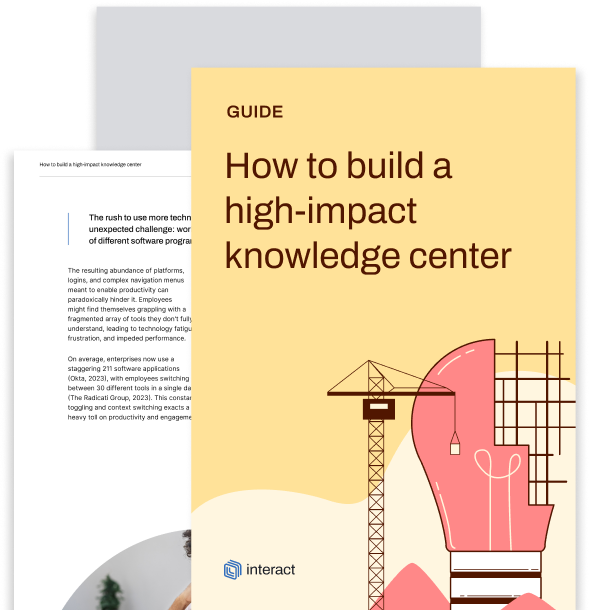
Want to learn more about optimizing your organization’s knowledge?
This free guide has ten practical steps to building a centralized knowledge hub that enhances productivity, innovation, and the employee experience.
© 2024 Interact - all rights reserved